
Recomienda este artículo a tus amigos:
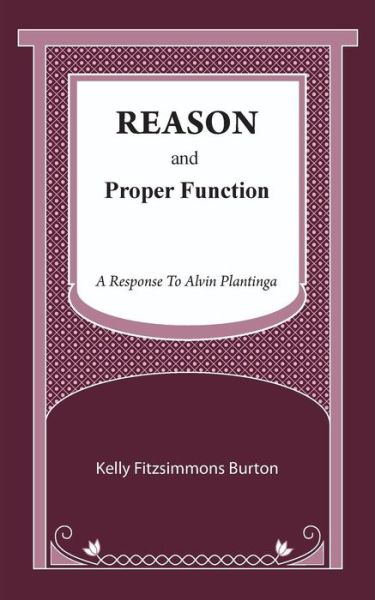
Reason and Proper Function Kelly Fitzsimmons Burton
Pedido desde almacén remoto
 Los regalos de Navidad se podrán canjear hasta el 31 de enero

Nuestros clientes opinan:


Reason and Proper Function
Kelly Fitzsimmons Burton
Alvin Plantinga, in Warrant: The Current Debate, notes that
there is a long history in Anglo-American epistemology that
traces back to the classical internalist views of Rene Descartes
and John Locke. Internalism is the view that an individual
has special access to that quantity or quality that makes true
belief into knowledge. This internalism, according to Plantinga,
is motivated by deontology - or epistemic duty fulfillment.
Closely connected with epistemic deontology is justification.
Justification (or what Plantinga prefers to call 'warrant') is that
quantity or quality, enough of which makes true belief into
knowledge. Plantinga strongly objects to the deontological
view of justification, claiming that no amount of duty fulfillment
can get us to knowledge. He says justification is neither
necessary nor sufficient for warrant.
In Warrant: The Current Debate (hereafter WCD) Plantinga
examines several versions of internalism - from Classical
and Post-Classical Chisholmian internalism, several forms of
coherentism, to reliabilism - to show that none of these views
get us to that quantity or quality enough of which makes true
belief into knowledge. Plantinga rejects all of these views,
arguing that what is needed is a view that takes into account the
proper function of our cognitive faculties. He then proposes to
give a more accurate account of warrant in Warrant and Proper
Function (WPF). Plantinga's theory is that a belief is warranted
if it is formed by cognitive faculties functioning properly in an
appropriate environment and according to a good design plan.
The purpose of this book is to examine Plantinga's view of
cognitive malfunction in connection with his view of warrant
and his rejection of the traditional view of justification. I
will argue that the cognitive faculty of reason does not and
cannot malfunction in the way that Plantinga either explicitly
or implicitly suggests. Consequently Plantinga's criticism of
justification does not stand. I argue further that if reason is
not subject to malfunction and is thus reliable, the traditional
view of justification - having appropriate reasons for belief
in conjunction with true belief, possibly with the addition of
a fourth condition (the carefulness criterion) - will get us to
knowledge.
| Medios de comunicación | Libros Paperback Book (Libro con tapa blanda y lomo encolado) |
| Publicado | 10 de junio de 2019 |
| ISBN13 | 9780578500249 |
| Editores | Public Philosophy Press |
| Páginas | 94 |
| Dimensiones | 127 × 203 × 6 mm · 108 g |
| Lengua | Inglés |
Mas por Kelly Fitzsimmons Burton
Mostrar todo

Ver todo de Kelly Fitzsimmons Burton ( Ej. Paperback Book y Book )